

ACU20FD Metal-Sealed Normally Open Valve Mass Flow Controller
Introduction
In vacuum applications, particularly in semiconductor manufacturing processes, metal-sealed mass flow controllers (MFCs) directly determine chip yield and equipment operational safety; however, due to high technical barriers, these products have long relied on imports. Normally open solenoid valves, as critical components in fluid control systems, are the preferred solution for safety-critical applications thanks to their “power-off-to-keep-flow” feature. ACCU Beijing Jingliang Technology’s ACU20FD series mass flow controllers and flow meters, with their short warm-up time, minimal zero drift, and high reliability, have broken the import monopoly and are perfectly suited for gas-control applications.
Industry Background
In the core processes of semiconductor manufacturing, precise control of gas flow directly determines chip yield and reliability. Processes such as chemical vapor deposition (CVD), physical vapor deposition (PVD), etching, and cleaning all rely on high-performance mass flow controllers (MFCs). However, when handling corrosive or toxic gases like silicon tetrachloride (SiCl₄), germanium tetrachloride (GeCl₄), phosphorus oxychloride (POCl₃), and boron trichloride (BCl₃), the requirements for controller sealing and gas compatibility are extremely stringent. Even a single leak can not only compromise the vacuum environment but also pose significant safety risks. Traditional MFCs, however, often reveal three major pain points:
• Seal failure: Corrosive gases penetrate the sealing interface, resulting in a highly toxic leak that poses a threat to personnel and the environment;
• Drift control: Corrosion of the sensor and inner walls of the flow channel leads to a significant degradation in accuracy over time;
• Low-pressure-difference failure: Under conditions of low inlet pressure or wide pressure-difference fluctuations, the valve fails to respond stably, resulting in control inaccuracies.
Even more challenging is that, in the event of an unexpected power outage, conventional MFC valves may shut off automatically, resulting in a loss of protective gas flow and cessation of chamber purging. This can instantly render expensive wafer substrates scrap and even trigger safety incidents. How, under the combined challenges of corrosive process media, wide pressure differential fluctuations, and sudden power outages, can we achieve control that ensures “no gas interruption, no gas leakage, and high precision”?
User Requirements
In a vacuum environment, gases are at low pressures, and flow rates typically fall within extremely narrow ranges, placing stringent demands on the measurement and control accuracy of controllers. Even minor deviations in flow can lead to defects in process equipment. In a vacuum environment, gases are at low pressures, and flow rates typically fall within extremely narrow ranges, placing stringent demands on the measurement and control accuracy of controllers. Even minor deviations in flow can lead to defects in process equipment.
Against this backdrop, an overseas customer in the vacuum industry is in urgent need of a batch of high-precision mass flow controllers that exhibit exceptional corrosion resistance, can handle a wide range of chloride precursors, and ensure uninterrupted gas supply even under power-off conditions.
The customer’s requirements are as follows:
1. Corrosion resistance : Compatible with highly corrosive chlorides such as silicon tetrachloride (SiCl₄), germanium tetrachloride (GeCl₄), phosphorus oxychloride (POCl₃), and boron trichloride (BCl₃), effectively preventing media leakage;
2. Multi-media precise measurement and control: Supports multiple gases, including nitrogen (N₂), argon (Ar), oxygen (O₂), hydrogen (H₂), sulfur hexafluoride (SF₆), and others, with anti-clogging features and precise measurement and control.
3. Power-Off Protection for Continuous Operation: Continuous gas supply is maintained even during power outages to prevent process interruptions caused by gas supply disruptions; furthermore, reliable data integrity and experimental safety are ensured in the event of an emergency shutdown.
4. Rapid Response and Adaptive Stability: The valve features rapid response, zero hysteresis, and a wide turndown ratio. Its performance is adaptive, enabling quick response to setpoint changes without overshoot.
Solution 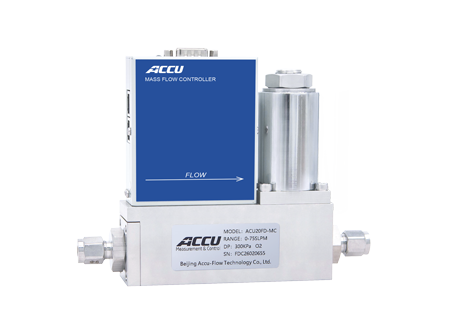

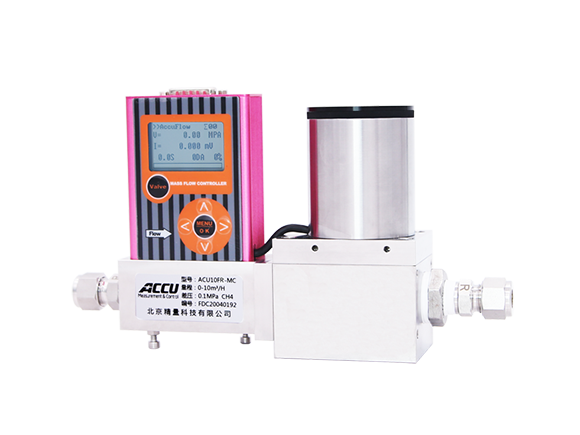
▲ ACU 20FD-MC Mass Flow Controller (Normally Open Valve)
In response to the requirements of the aforementioned operating conditions, leveraging its deep technical expertise in precision fluid measurement and control, ACCU Beijing Precision Technology (hereinafter referred to as “ACCU”) has custom-designed the ACU20FD series of high-accuracy mass flow controllers—available in both metal-sealed normally open valves and elastomeric-sealed normally open valves—for this customer. Based on the capillary heat-transfer differential-temperature calorimetry principle, this series directly measures mass flow rate and is unaffected by fluctuations in medium temperature and pressure. The entire product line comes standard with normally open valves and features a customized metal-seal design that eliminates conventional, corrosion-prone sealing components. It is specifically engineered to meet the extreme demands of semiconductor vacuum applications and other manufacturing processes, covering all scenarios from laboratory R&D to full-scale production lines.
Core Advantages of the ACU20FD Series Mass Flow Controllers:
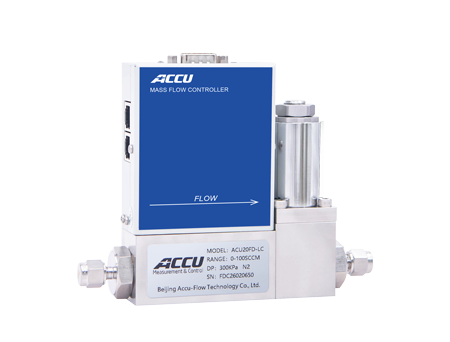

▲ ACU 20FD-LC Normally Open Valve Mass Flow Controller
The ACU20FD-LC high-precision normally-open mass flow controller features a normally-open valve design. In the event of an unexpected power outage or system failure, the valve does not mechanically close; instead, it automatically remains fully open. This ensures continuous gas supply to the reaction chamber, thereby meeting process design requirements. At the same time, this design provides a reliable operating environment for post-failure data tracing and safe handling, truly achieving “no loss of gas supply during power outages and no loss of control in abnormal conditions.”

▲ ACU 20FD-LC Mass Flow Controller (Metal-Sealed Normally Open Valve)
2. Metal sealing to eliminate gas leakage.
The ACU20FD series metal-sealed normally open mass flow controllers are specifically designed for highly corrosive chlorides such as silicon tetrachloride (SiCl₄), germanium tetrachloride (GeCl₄), phosphorus oxychloride (POCl₃), and boron trichloride (BCl₃). They feature exceptionally tight stainless-steel flow paths and a metal-seal construction, eliminating conventional polymeric seals that are prone to permeation-induced corrosion. The all-metal hard-seal design rigorously limits the helium leak rate to below 1 × 10⁻¹⁰ Pa·m³/s, meeting semiconductor-grade ultra-high sealing standards. This effectively prevents gas leakage, ensuring the stability of the vacuum environment while mitigating safety risks associated with the release of specialty gases. As a result, personnel and environmental safety are safeguarded, and equipment maintenance frequency and downtime costs are significantly reduced.
3. High-precision, stable control
The ACU20FD series operates on the principle of capillary heat-transfer differential-temperature calorimetry, ensuring that flow measurement is unaffected by fluctuations in medium temperature and pressure. This series delivers an actual measurement accuracy of ≤±0.5% FS and repeatability of ≤±0.2% FS, with a control ratio as high as 50:1. Coupled with a tubular分流 (diversion) structure design, it achieves precise control of extremely low flow rates while exhibiting resistance to clogging, short warm-up times, and minimal zero drift. Moreover, it is immune to pressure fluctuations in vacuum environments and to variations in the thermophysical properties of gases, thereby fundamentally guaranteeing the accuracy and stability of flow control under vacuum conditions.
Operating condition parameters:

Note: The above parameters represent the customized configuration for this solution. ACCU can, based on the customer’s actual production conditions, provide solutions with different measurement ranges, interfaces, and communication protocols.
Scope of Application

The ACU20FD series of high-precision mass flow controllers likewise demonstrate irreplaceable safety and performance benefits in the following fields:
Semiconductor manufacturing: Precise delivery of gases such as silane and ammonia in processes like chemical vapor deposition (CVD), atomic layer deposition (ALD), and plasma etching requires ultra-high accuracy (±0.5% of reading or better), excellent repeatability, and millisecond-level response.
Photovoltaic Industry: In the production of silicon-based and thin-film solar cells, precise control of the flow rates of silane, ammonia, and hydrogen directly affects the cells’ photoelectric conversion efficiency and manufacturing yield.
Hydrogen Energy and Fuel Cell Testing: The hydrogen flow rate can span more than 1:100, ranging from milliamp-level low currents to the rated current, necessitating that the MFC feature a wide turndown ratio, explosion-proof design, and millisecond-level response.
Lithium-ion battery material preparation: In the fluidized-bed CVD process for silicon–carbon anodes, the precision of flow-rate control for silane and acetylene directly affects the uniformity of silicon deposition and product consistency.
Biopharmaceuticals: Precisely controlling the mixing ratios of oxygen, carbon dioxide, and nitrogen in bioreactors to create an optimal gaseous environment for cell growth.
Scientific research experiment : In applications such as catalytic reaction evaluation, new material synthesis, and trace pollutant analysis, precise control of trace gases is subject to stringent requirements.
Conclusion
Gas mass flow controllers serve as the “unsung conductors” of precision industrial manufacturing, and their critical role is self-evident, particularly in the measurement and control of ultra-low flow rates. The ACU20FD series of thermal mass flow controllers and meters leverages core advantages such as direct mass flow measurement, elimination of the need for temperature and pressure compensation, and exceptional performance in low-flow applications. Combined with the dual safeguards of a normally-open valve that maintains flow when power is off and metal-sealed construction that ensures zero leakage, this solution delivers a robust measurement and control system capable of withstanding extreme operating conditions in high-end sectors such as semiconductors, photovoltaics, hydrogen energy, and lithium-ion batteries.
Related Products
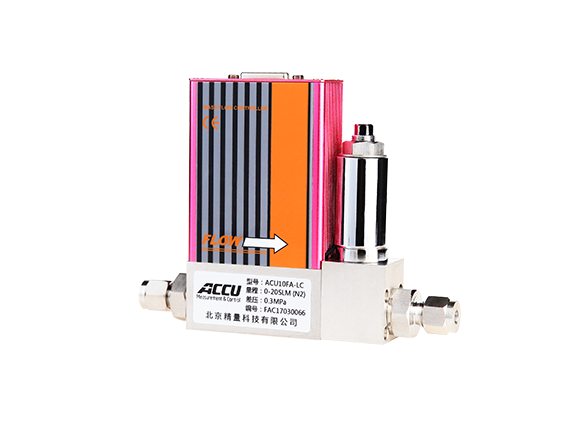
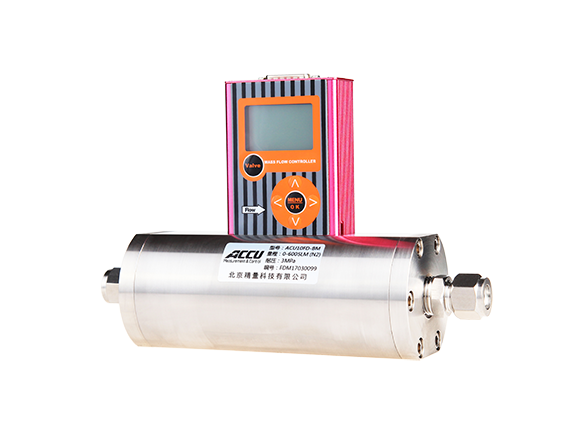
ACU20FD Normally Open Valve Series


Contact Information
Address: Room 1522/23,Building B,Ruichuang International Center,No.8Wangjingdong Road,Chaoyang District,Beijing (R&D Department)


Leave a message
If you are interested in our products, please leave your email address, and we will contact you as soon as possible, thank you!