

Multi-component dynamic gas‑mixing system—enabling precise gas blending across multiple fields
In applications such as metrological testing, environmental monitoring, scientific research, and industrial production, multi-component dynamic gas‑mixing systems often operate continuously for hours or even days. The system’s accuracy, response time, stability, and scalability directly determine the reliability of experimental data and the effectiveness of process control. Consequently, these systems typically need to simultaneously regulate the flow rates of multiple gas components, ensuring precise concentrations and uniform mixing. A multi-component dynamic gas‑mixing system independently developed by ACCU. , Based on mature thermal and differential-pressure gas mass flow control technologies. Combining an integrated structural design with intelligent operational logic, it has become a gas distribution device that stands out for its comprehensive performance in the current market.

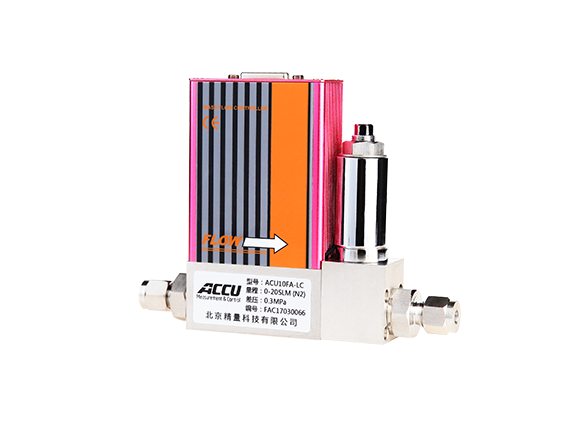
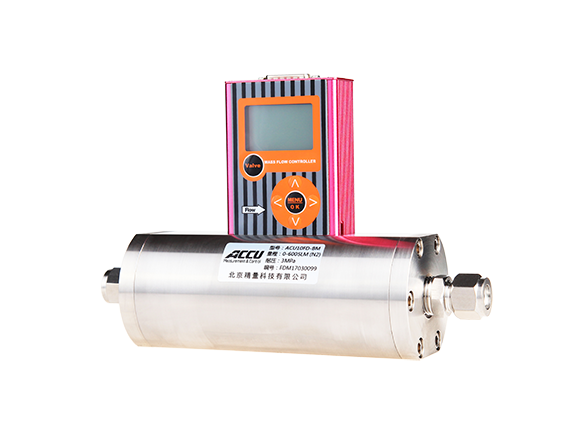
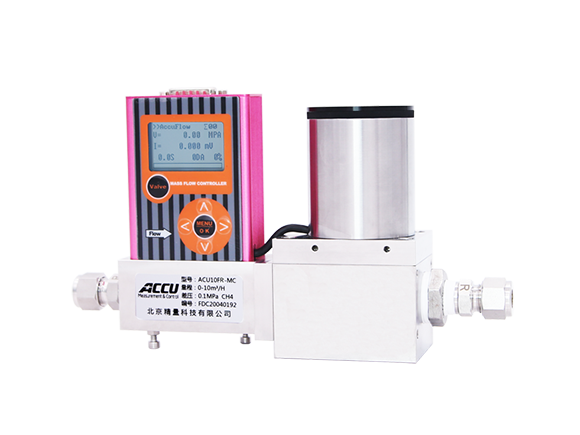
The core of the ACCU multi-component dynamic gas‑mixing system is the ACU10FD series of digital mass flow controllers. These controllers comprise a mass flow sensor, laminar flow splitter, control valve, and amplification/control circuitry, and they measure gas mass flow using the capillary‑based heat‑transfer differential‑temperature calorimetry principle. Unlike conventional analog controllers that rely on analog voltage or current signals, the ACU10FD employs digital input and output: users issue commands via digital communication interfaces such as RS‑232/485 or Modbus, with flow setpoints transmitted in pure digital form, thereby eliminating signal‑transmission errors entirely. Real‑time flow data is fed back to a high‑performance microprocessor, which applies a PID algorithm to precisely drive the control valve, ensuring accurate regulation across the entire measurement range.
For the requirements of different customers or technical solutions, we offer an even wider range of flow controllers, such as: Differential pressure–based, low-pressure-drop series, high-pressure‑resistant series …is capable of meeting the customized requirements of a wider range of applications.

In terms of core performance metrics, the ACU10FD series delivers outstanding results: Flow accuracy reaches ±1.0% of full scale, linearity is ±0.5% of full scale, and repeatability remains stable at ±0.2% of full scale. Additionally, the ACU20FD and 30FC series offer even higher precision, with accuracies better than 0.5% of full scale; they maintain this high level of accuracy even at high flow rates up to 3,000 SLM. Some models achieve response times as fast as less than 0.2 seconds, meeting demanding rapid‑response requirements. More importantly, the thermal mass flow measurement principle is unaffected by fluctuations in ambient temperature and pressure, effectively eliminating the metering errors that arise in conventional volumetric flow meters due to changes in temperature and pressure.

To address the complex requirements of multi-component gas blending, the ACCU system employs a modular architecture. The standard configuration offers 3 to 5 independent gas‑mixing channels, which can be flexibly expanded to 7 to 9 or even more channels based on user needs. Each channel is equipped with its own mass flow controller, ensuring precise control of the flow rate for every gas component.
In practical applications, ACCU Multi-Component Dynamic Gas Mixing System It can simultaneously prepare multi-component gas mixtures or independently adjust single-component gases, meeting diverse gas‑mixing requirements. In terms of material safety, the gas‑delivery tubing and the interior of the mixing chamber can be constructed from corrosion‑resistant materials such as 316L stainless steel and perfluoroelastomers. It possesses excellent chemical inertness and corrosion resistance. The system leak rate is as low as 1×10⁻⁹ Pa·m³/s, Excellent airtightness performance 。

Thanks to its outstanding performance, the ACCU multi-component dynamic gas‑mixing system has been deployed across a wide range of applications:
Petrochemical Industry: It is used to precisely control the gas mixing ratio in the production process, ensuring product quality and production safety.
In scientific research experiments: It is used in materials science, chemical engineering, and other fields to investigate the effects of varying gas mixture ratios on experimental outcomes.
Environmental Testing: It can simulate various scenarios, such as vehicle exhaust and industrial VOC emissions, to verify the sensitivity and selectivity of detection instruments, as well as… Application of blended gas in ultra-high-temperature flue-gas denitrification catalysts.
Catalyst evaluation field: It enables dynamic gas blending under high temperature and high pressure, thereby accelerating research into catalytic reaction mechanisms.
Biopharmaceutical R&D: The incubator’s climate can be precisely controlled using carbon dioxide, oxygen, and nitrogen, providing a programmable gaseous environment for dynamic cellular response experiments.
Environmental monitoring field: It is necessary to prepare complex standard gas mixtures that contain multiple pollutant gases—such as sulfur dioxide, nitrogen oxides, and volatile organic compounds—as well as various background gases, enabling precise and stable delivery of such multi-component gas mixtures.
Combustion process: Hydrogen–oxygen combustion; combustion processes involving multi-component gas mixtures, such as alkanes and natural gas.
The ACCU multi-component dynamic gas‑mixing system, with its high precision, rapid response, and robust scalability, provides reliable technical support for the precise blending of multi-component gases and is becoming an indispensable piece of foundational equipment in fields such as petrochemicals, scientific research and experimentation, environmental monitoring, catalyst evaluation, and biopharmaceuticals.
Related Products

ACU20FD Normally Open Valve Series


Contact Information
Address: Room 1522/23,Building B,Ruichuang International Center,No.8Wangjingdong Road,Chaoyang District,Beijing (R&D Department)


Leave a message
If you are interested in our products, please leave your email address, and we will contact you as soon as possible, thank you!