

Multi-component Dynamic Gas-Blending System for Combustion Processes
Introduction
According to industry data, the domestic market for laboratory gas-control equipment exceeded RMB 4.5 billion in 2023, with dynamic gas-blending systems accounting for 32% of the market and continuing to expand at an annual growth rate of 18%. Multi-component dynamic gas-blending systems are high-precision instruments designed to precisely control gas-mixing ratios and flow rates, and they are widely used in semiconductor manufacturing, university research, industrial spray combustion processes, and new-energy development. Their core function is to dynamically adjust the flow rates and concentrations of multiple gases, thereby providing precise and controllable gas environments for the semiconductor, research, and industrial sectors.
Project Introduction

In applications where stringent requirements are imposed on gas mass flow—such as spray combustion processes in automotive, marine, and aero-engine systems, including high-pressure injection, atomization quality, and fuel–air mixing—the optimal fuel–oxygen ratio is critical for achieving efficient, clean combustion. The accuracy and stability of dynamic air-fuel control systems serve as the core enabler for ensuring production stability.
However, in applications requiring precise mixing of multi-component gases, countless variables—such as temperature, pressure, flow-rate accuracy, and gas properties—are intricately interwoven. Conventional volumetric flow meters are highly sensitive to variations in temperature and pressure, making it difficult to ensure the repeatability and stability of the gas mixture ratio.
Against this backdrop, customers are in urgent need of a highly precise, multi-component dynamic gas-blending solution that can effectively mitigate issues such as incomplete combustion, temperature instability, and product-quality exceedances caused by fluctuations in gas flow—thereby not only reducing raw-material consumption but also significantly enhancing the quality of the final product.
The customer’s requirements are as follows:
1. High-precision proportioning
Precisely control the mixing ratios and flow rates of fuel gas (such as hydrogen), oxidizer (such as oxygen or air), and diluent, in conjunction with optimal atomization performance, to achieve complete combustion, low emissions, and high efficiency, while ensuring stable concentration accuracy of the final mixed gas and robust immunity to environmental disturbances.
2. Supports flexible customization
It is adaptable to the diverse experimental and production conditions of spray combustion, meeting the independent gas-distribution control requirements for different gaseous media and measurement ranges, and allowing flexible adjustment of the gas-distribution ratio based on process parameters.
3. Stable and efficient
The gas distribution system must exhibit excellent long-term stability and rapid response, thereby reducing process commissioning time and enhancing both experimental and production efficiency.
Solution

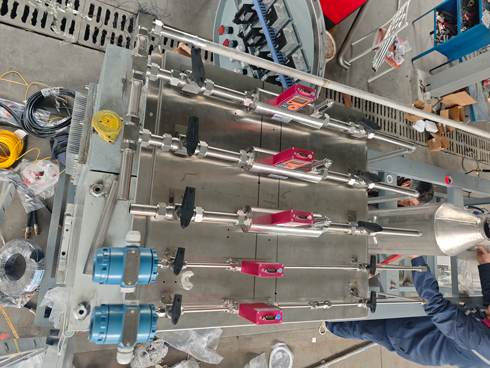
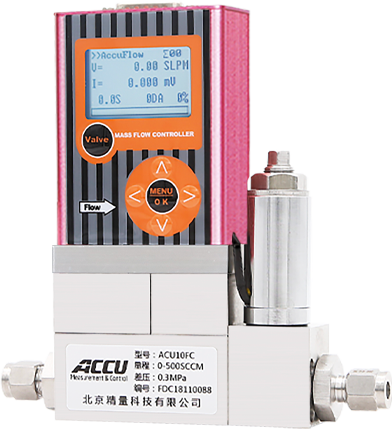
To meet the customer’s need for matching diverse process conditions, leveraging its deep technical expertise in precision fluid measurement and control, ACCU Beijing Precision Technology (hereinafter referred to as “ACCU”) has custom-designed a multi-component dynamic gas blending system with a five-inlet, four-outlet configuration. The solution centers on the ACU10FD series of digital gas mass flow controllers, which offer high accuracy, excellent long-term stability, and rapid response, and employs capillary thermal mass flow control technology to achieve precise gas mixing and proportional delivery. This approach effectively mitigates issues such as incomplete combustion, temperature instability, and excessive by-product levels that can arise from fluctuations in gas flow.
I. Core Advantages of the ACCU Multi-Component Dynamic Gas Mixing System
The ACU10FD mass flow controller consists of a mass flow sensor, laminar flow splitter, flow-control regulating valve, and amplification control circuit, among other components. It is designed based on the thermal conduction distribution effect, in which heat transfer by the flowing fluid alters the temperature distribution along the wall of the measuring capillary.
1. High precision, high stability
This gas blending system solution supports simultaneous blending of multi-component gas mixtures as well as independent blending of single-component gases, thereby meeting diverse gas-blending requirements. Each channel is equipped with an ACU10FD mass flow controller featuring repeatable accuracy of up to ±0.2% of full scale and an ultra-low leak rate of 1×10⁻⁹ Pa·m³/s, ensuring outstanding gas-tightness. The number of gas-flow channels can be customized to suit specific needs, and the flow-range configuration is also highly flexible. Moreover, the system enables seamless switching among different gas types, effectively addressing the complex requirements of various fuel systems.
2. Multi-channel Integration and Flexible Expansion
This gas blending system solution supports simultaneous blending of multi-component gas mixtures as well as independent blending of single-component gases, thereby meeting diverse gas-blending requirements. Each channel is equipped with an ACU10FD mass flow controller boasting a repeatability of ±0.2% of full scale, and the number of gas channels can be customized to suit specific needs, with flexible configuration of the flow range as well. The system also enables seamless switching among different gas types, effectively addressing the complex requirements of various fuel systems.
3. Safe and reliable
To meet the demanding gas-delivery requirements in diverse gas environments—particularly for corrosive, flammable, and explosive gases—our mass flow controllers have been specifically engineered in terms of material selection and surface treatment. The gas pathways and the interior of the mixing chamber are constructed from corrosion-resistant materials such as 316L stainless steel and perfluoroelastomers, which not only exhibit exceptional chemical inertness and corrosion resistance but also incorporate multiple safety features, including leak prevention and flashback protection. These measures ensure stable gas purity from the source and enable safe, controllable gas delivery throughout the entire process. The core components deliver consistent performance and high reliability, maintaining precise gas-metering accuracy while significantly extending equipment service life and substantially reducing customers’ long-term operating and maintenance costs.
II. Operating Condition Parameters:
|
Device Model |
Medium |
Measurement range |
Withstand voltage (Optional high-pressure model) |
Working pressure differential (Customizable) |
|---|---|---|---|---|
|
10FD-BC |
air |
0~(300SLM...750SLM) |
3MPa |
0.3-0.5MPa |
|
10FD-LC |
Hydrogen |
0~(2 SCCM...20 SLM) |
||
|
10FD-LC |
Oxygen |
0~(2 SCCM...20 SLM) |
Note: The above parameters represent the customized configuration for this solution. ACCU can provide solutions with different measurement ranges, interfaces, and communication protocols based on the customer’s actual production conditions.

Scope of Application

Thanks to its outstanding performance, the ACCU multi-component dynamic gas blending system plays a pivotal role in the following fields:
• Chemical research: It is used in research on reactions such as the hydrogenation of carbon dioxide to methanol in fields like petrochemical and coal chemical industries.
• Laboratory environment: Researchers require mixed gases at specific concentrations to test catalysts and to examine the effects of varying pollutant concentrations on the gas mixture.
• Biomedical: It provides precise gas mixing ratios and stable gas environments for biomedical experiments such as cell culture and biosensor development, thereby supporting research on cellular metabolic processes and drug mechanisms of action. In hospitals, oxygen is blended with ambient air to deliver oxygen-enriched air or anesthetic gases to patients.
• Food Industry: Packaging is filled with mixed gases, such as nitrogen and carbon dioxide, to prevent food oxidation and spoilage.
• Daily applications: Welding shielding gases, gas analyzer calibration, bulb filling, insulating glass inflation—and even engine combustion control in automobiles—all rely on precise gas mixing.
Conclusion
Technological advancement is limitless, yet precision can come infinitely close to reality. As a leader in China’s precision fluid measurement and control sector, ACCU consistently drives innovation and remains customer-centric, offering tailored, integrated solutions that span core equipment selection, precise parameter matching, and full-system integration—thereby helping enterprises achieve intelligent production upgrades and maximize energy efficiency.
Previous page
Previous page:
Related Products


Contact Information
Address: Room 1522/23,Building B,Ruichuang International Center,No.8Wangjingdong Road,Chaoyang District,Beijing (R&D Department)


Leave a message
If you are interested in our products, please leave your email address, and we will contact you as soon as possible, thank you!