

Breaking the Limits of Force Control: Application of the ACU20PCD Pressure Controller in the Silver Sintering Process for Silicon Carbide (SiC) Power Modules
I. Industry Background: The “Thermal” Challenges of SiC Packaging and the Rise of Silver Sintering
As new-energy vehicles (NEVs) evolve toward 800V and even higher-voltage platforms, silicon carbide (SiC) power modules are rapidly replacing traditional IGBTs due to their outstanding high-voltage, high-frequency, and high-temperature performance. However, SiC chips exhibit extremely high junction temperatures, and conventional soldering processes—with a melting point of approximately 220°C—are highly susceptible to thermal fatigue and even secondary melting under prolonged high-load conditions.
To thoroughly address the bottlenecks in heat dissipation and reliability, Pressure-assisted silver sintering has become the standard process for high-end SiC module packaging. This process utilizes pure silver particles under high temperature and high pressure. Solid-state atomic diffusion occurs, resulting in a dense pure-silver interconnect layer with a melting point as high as 961°C. In this process, the pressure-control accuracy of the packaging equipment directly determines the porosity of the sintered layer and the chip yield, making it the most critical “mechatronic” technological barrier in the entire packaging system.
II. Customer Pain Points: Stringent Force-Control Requirements for a 30 kN Sintering Machine
In A leading domestic manufacturer of automotive-grade SiC power modules On the 30 kN (approximately 3-ton) large-area silver sintering mass-production line, the core equipment adopts a “fixed high-pressure clamping combined with cylinder-based flexible pressing” design. Under this architecture, no active pressurization mechanism is installed in the gas supply system. The sole air source and force-control hub is the front-end proportional pressure controller.
Customers in this process segment face three extremely demanding force-control challenges:
1. Zero Overshoot
SiC wafers are extremely expensive and highly brittle. At the moment of pressurization, if pneumatic control results in pressure overshoot, the instantaneous peak of the cylinder’s thrust can directly crush the wafer, leading to exorbitantly high scrap losses.
2. Extremely Small Static Error Under High-Voltage Drive
To generate a substantial thrust of 30 kN within a compact cylinder approximately 60 mm in diameter—corresponding to a sintering pressure of 15–30 MPa on the chip surface—the controller must stably regulate the air supply pressure up to 10 MPa and maintain pressure stability throughout a prolonged high-temperature dwell period lasting more than ten minutes; otherwise, voids are highly likely to form in the sintered layer.
3. Compatibility between high resolution and wide measurement range
From the initial micro-pressure lamination during sintering to the peak curing stage in the later phase, the controller must maintain high-precision linear response across an extremely wide pressure range to accommodate the production requirements of modules of varying sizes.
III. Solution: ACU20PCD Intelligent Pressure Controller

▲ ACU20PCD High-Pressure Intelligent Pressure Controller (10 MPa standard / up to 40 MPa supported)
In response to the aforementioned extreme operating conditions, the 30 kN sintering machine on this production line has been fully and mass-produced using ACCU (Beijing Jingliang Technology) Model ACU20PCD High-Pressure Intelligent Pressure Controller , perfectly overcame the stringent process challenges associated with silver sintering of SiC.
Core Technological Advantages:
• Ultra-high-pressure fluid control capability (10 MPa standard / up to 40 MPa supported)
Conventional electrical proportional valves on the market typically handle only low-pressure air below 1.0 MPa. Thanks to its outstanding mechanical valve-body design and high-pressure-resistant sealing technology, the ACU20PCD can directly and precisely control 10 MPa (up to 40 MPa as an optional configuration) high-pressure nitrogen or compressed air. This game-changing high-pressure processing capability enables equipment manufacturers to achieve ton-level thrust using extremely compact actuating cylinders, significantly reducing the footprint of the equipment and dramatically enhancing the dynamic response of the pneumatic circuit.
• Electromechanical Closed-Loop Algorithm with Zero Overshoot
To address the critical challenge of SiC chips being highly prone to fracture, the ACU20PCD integrates a high-frequency-sampling precision pressure sensor and a deeply optimized PID closed-loop control algorithm. Under step reference signals, the valve spool achieves exceptionally smooth dynamic optimization. Achieve true “no overshoot” while rapidly building pressure. , much like equipping the device with an intelligent, flexible shock-absorption system that minimizes the risk of chip damage due to excessive stress.
• Ultimate steady-state accuracy and intuitive digital interaction
The ACU20PCD features an industrial-grade, robust metal valve seat and an intuitive, full-color digital user interface. Its steady-state control error is exceptionally low, enabling precise maintenance of the set pressure and ensuring continuous, uniform compression of micron-sized silver particles during the sintering process. This ultimately helps customers produce high-quality thermal interface materials with ultra-low porosity (<5%) and minimal thermal resistance.

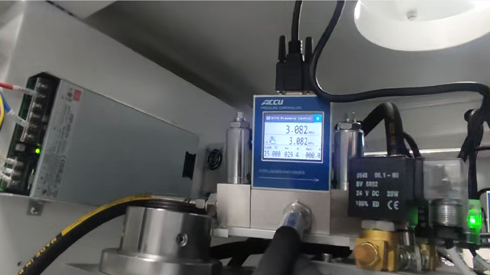
▲ Real photos of customer application feedback
IV. Customer Value and Benefits

By integrating the ACU20PCD pressure controller, this customer’s high-end silver sintering equipment has achieved truly flexible and precise pressurization:
• Significant improvement in yield: The issue of chip cracking caused by transient pressure surges during the initial pressurization phase has been completely resolved.
• Extremely high process consistency: The highly stable high-voltage output ensures consistent densification and thermal resistance of the sintered layer within each batch of SiC power modules, fully meeting the stringent qualification standards for automotive-grade devices.
• Significant system simplification: A single controller alone is sufficient to implement complex high-pressure control logic, completely eliminating the need for costly and bulky multi-stage pneumatic boosters or servo-hydraulic power units, thereby reducing overall equipment manufacturing costs and simplifying subsequent maintenance.
Conclusion:
In the field of advanced semiconductor packaging, breakthroughs in microscale processes often hinge on the ultra-precise control provided by macroscopic equipment. The ACU20PCD is not merely an outstanding pressure controller; it serves as a pivotal electromechanical hub that bridges “pneumatic control” and “precision manufacturing,” thereby delivering the most robust foundational fluid-control support for the rise of domestically produced high-end semiconductor equipment.
Previous page
Previous page:
Related Products


Contact Information
Address: Room 1522/23,Building B,Ruichuang International Center,No.8Wangjingdong Road,Chaoyang District,Beijing (R&D Department)


Leave a message
If you are interested in our products, please leave your email address, and we will contact you as soon as possible, thank you!